Mariposa Journal
Mariposa Corporate Gifts: What Is a Corporate Gift Card Really Worth?
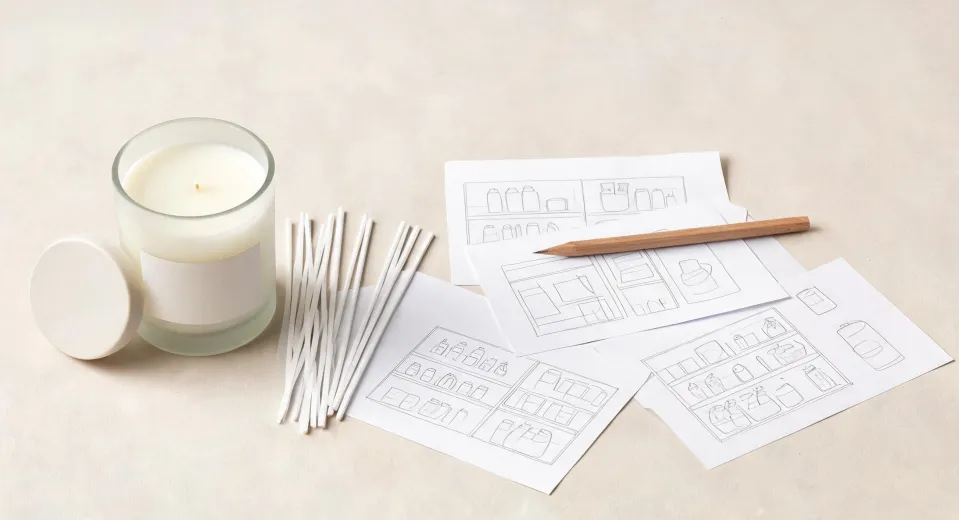
I'm the office administrator who handles purchasing for a 150-person company. I manage all corporate gifting, event supplies, and vendor relationships—roughly $90,000 a year across six to eight suppliers. I've been doing this since 2020, and I have a strong opinion. Corporate gift cards are the lazy option, and Mariposa candles and dinnerware are the smarter buy when you look at total cost of ownership.
Most buyers compare the face value of a gift card to the invoice on a candle. That's like comparing a boarding pass to a luggage tag. It's the wrong level of thinking.
Not because I'm sentimental. I'm not. I'm the person who reconciles the corporate card at the end of the month. Sentiment doesn't show up on a P&L. But wasted spend does, and a gift that gets ignored is wasted spend.
What is a corporate gift card, really?
Let's define terms. A corporate gift card is a prepaid card your company gives to an employee, client, or partner. It can be spent wherever the card network is accepted. I've ordered hundreds of them. They're easy. They're also forgettable.
Here's the thing: a gift card is structurally identical to cash. And as cash, it tends to disappear into routine spending. Someone gets a $50 card, uses it on groceries, and the interaction is over. The card didn't say anything about your company, your values, or your relationship. It said: here's the minimum possible consideration.
The “everyone loves a gift card” assumption is a leftover from the era when prepaid cards felt modern and even kind of personal. That time has passed. Today, a card can feel like an HR placeholder. IRF studies on non-cash rewards consistently show that prepaid cards are one of the most preferred reward types (Source: Incentive Research Foundation, 2024). But preference and impact are not the same thing. I'd rather give a candle someone remembers than a card someone registers and forgets.
I didn't always think this way. When I took over purchasing in 2020, gift cards were my default. They were safe. No returns. No packaging. No delivery date to hit. But then I started paying attention to outcomes. I asked two department heads which corporate gifts people actually remembered from the year before. The answers were physical items—a nice mug, a photo frame, an engraved pen. No one remembered a card.
That's the real causation reversal. People assume gift cards work because they're flexible. The reality is they work at the point of purchase and fail at the point of memory. If the gift isn't memorable, the relationship value is basically zero.
Price vs. total cost: the candle math
Let me give you a concrete example from 2023. We were planning a client appreciation push, and I found a cheaper vendor for scented candles. Not Mariposa—just a discount supplier. The quote was $11 per candle, roughly 40% below what I'd normally spend. I ordered 80 candles—actually 92; I'm mixing it up with another project—and paid a deposit.
They arrived two days late, at our main office instead of the event venue, and three boxes were crushed. The candles themselves were fine, but the packaging was destroyed. We had to reorder presentation boxes at $4.50 each and pay for expedited delivery. When I added the shipping, the boxes, my assistant's time, and the phone calls to sort out the mess, the $11 candles cost us about $19 each. The cheap quote became the expensive order.
That's when I built a total cost of ownership checklist. It includes the base price, yes, but also shipping reliability, invoice accuracy, billing admin time, on-time delivery risk, reprint or rework costs, and the cost of a gift that fails to impress.
The lowest quoted price never wins that checklist. I'm not saying every cheaper vendor fails. I've worked with some excellent small businesses. But a 20% saving on unit price evaporates the moment you have to touch the order twice. Triple the touches and you're in the red.
Why Mariposa makes my job easier
In 2024, I tested Mariposa for corporate gifts. Their quote was higher than the discount supplier. I'll be honest: I hesitated. I went back and forth for about a week because the gift budget was tight and finance was watching.
But the first order changed my mind. We bought 75 candles and 25 dinnerware sets for a leadership retreat gift. One account manager handled everything. The box arrived ready to wrap. The invoice matched the purchase order to the cent. And the Mariposa logo on the packaging gave the whole thing a sense of care that a generic branded envelope doesn't have.
The dinnerware piece was the surprise. I know what you're thinking: dinnerware is a risky gift because taste is personal. True. But we picked an elegant, simple collection that felt intentional without being so specific that it only works with one aesthetic. The candles were equally safe. And the response from recipients was noticeably warmer than when we handed out gift cards.
Also important: the Mariposa logo did more work than our own logo. We'd tried branding generic gifts with our company logo, and it read as swag—cheap, promotional, disposable. But a Mariposa logo signals quality. Recipients see the packaging before they even open the box. That's a moment of delight, not a pitch.
What about the search confusion?
One honest caveat. If you've searched mariposa apartment homes, you might have landed here by accident—that's a property company, not a gift brand. It's a genuine branding challenge: the name “Mariposa” is shared with apartment communities, a butterfly species, even a city. I worried at first that this would undermine corporate gifting. Would my CFO think I'd picked a vendor with an identity crisis?
In practice, it doesn't matter. By the time a gift arrives, the recipient isn't doing a search audit. They're opening a beautifully wrapped candle or a dinnerware set. Brand confusion exists mainly in Google results, not in the experience. And if someone does search Mariposa later, they'll find the gift company whose product they already have on their shelf.
But gift cards are easier—aren't they?
Let's address the obvious objection. Gift cards cut out shipping, returns, personal taste, and vendor risk. I get it. I've had weeks where I was tired and wanted to click “deliver by email” instead of coordinating a boxed gift. The ease is real.
But here's what that ease costs. A gift card can sit in an inbox. It gets archived. It expires or gets forgotten. Even if it's used, it doesn't change how the recipient feels about your company. That's a hidden cost, and for a gifting program it's the biggest line item.
So no, I'm not saying gift cards are worthless. I'm saying they're worth less than their face value in relationship terms. A well-chosen candle or a quality dinnerware set keeps its value because the recipient keeps it, uses it, and remembers who gave it. That's the entire point.
My rule after 5 years
I still calculate total cost of ownership before comparing vendors. I ask about packaging, invoicing, and delivery windows before I ask about discounts. I'd rather pay more for a Mariposa candle that arrives on time and looks intentional than save 20% on something that makes me chase down a delivery driver.
People think expensive gifts perform better because they're expensive. The truth is they perform better because more thought went into them. Mariposa isn't just a premium price tag. It's a vendor that lets me hand a beautiful box to an employee or client and feel confident that the gesture lands.
So next time you're weighing a gift card against a physical gift, don't stop at the unit price. Look at the total cost of ownership. The gift that gets remembered is the gift that was worth buying.

Elise Laurent is a crystal and decorative glass quality analyst covering crystal figurines, vases, ornaments, suncatchers, and gift glassware. She examines ISO 6486-1 where food-contact glass dinnerware applies, then uses polarized strain inspection, dimensional checks, surface-defect grading, and refractive clarity to compare decorative pieces outside that scope. Her work helps sourcing teams choose materials, finishing routes, and protective packaging without confusing visual brilliance with verified durability.