Mariposa Journal
Don’t Lead with the Candle: Better Welcome-Home Gifts Start at the Table
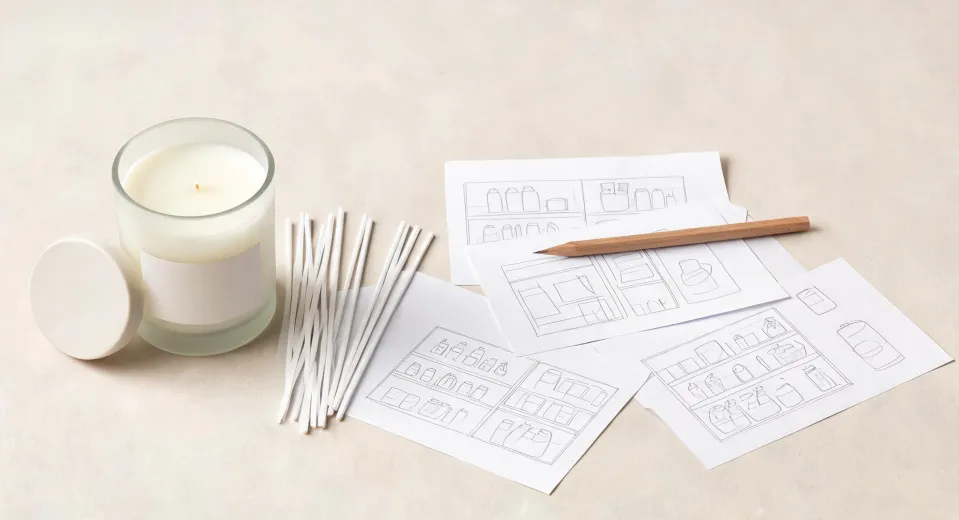
A move-in gift should not be built around a scented candle. I know that sounds odd coming from someone at a gift company, but I have a good reason for the opinion. Candles are lovely finishing touches. They are not foundations. After seven years of managing corporate welcome-home orders at mariposa, I have watched too many beautifully wrapped candle boxes get opened, admired, and then saved for a special occasion that never arrives. The gifts that actually get used are the practical ones, and they get used on the first ordinary Tuesday.
If you buy welcome gifts for tenants, new homeowners, or transferred employees, here is my position: build the gift around something that lives on the table—dinnerware or a tea set—and treat the scent products as the atmosphere, not the main event.
Why should you trust that opinion? Since 2017, I have handled the B2B side of mariposa gifts, where companies order 25 or 500 welcome-home gifts instead of one. I have personally made and documented 31 significant mistakes in that role, totaling roughly $18,400 in wasted client budget. Those mistakes became a pre-order checklist I hand to every new account manager. The first line on that checklist is simple: does the recipient still use this next week?
Bread and salt were the original housewarming gifts
Older housewarming traditions understood this better than we do. Guests did not arrive with decorative objects. They brought bread and salt, and often honey or wine. Bread meant the house would never go hungry. Salt meant the home would stay welcoming and protected. Honey was a wish for sweetness. These were not gifts for a shelf—they were ingredients for the first meal in the new kitchen. The wish was built into something the family would use within hours.
That principle is the part worth keeping: a gift for a new home should participate in the daily routines of that home. Around 2015, the candle replaced the bread basket, and by 2019 many corporate welcome boxes were basically a scented candle, a soap, and something with the company logo on it. The boxes photographed beautifully. But they were beautiful to open, not useful to live with.
My first assumption was completely backward
When I started this role in 2017, I believed a welcome gift should feel unmistakably like a gift. An elegant candle. A polished holder. Something that made the unboxing feel special. I focused on the first thirty seconds.
I was wrong. The order records made that clear over time. The candle-only orders were rarely repeated. The accounts that moved to dinnerware-led and tea-set-led boxes came back season after season. The unboxing lasts thirty seconds. Daily use lasts for years.
Renters are not scared of permanence
Property managers usually push back here. They tell me their tenants move every year or two, so a heavy set of plates feels like the wrong choice. I used to agree with that logic. I no longer do.
People who move between rentals do not keep much. The possessions they pack become the things that make the next place feel like theirs: the coffee maker, the good towels, the plates. A half-burned candle gets left behind. A proper dinnerware set goes into the next moving box because it still has years of use ahead of it. That is the quiet difference between a gift that decorates and a gift that belongs to someone's life.
We work with a property-management group that handles homes for rent in Mariposa, CA. Their first order with mariposa, back in 2021, was a candle and a candle holder for new tenants. The tenants were gracious, but at move-out most of the candles had never been lit. They had been saved for later, and later never came. In 2023, that same client piloted a new version: a boxed set of dinnerware with a tea set as the secondary piece. Their contact told me tenants now use the tableware within the first week, and most pack it up and take it to the next place. Porcelain did not frighten the renters. It gave them something worth keeping.
Can you make your own reed diffuser? Sure. And no.
Because scent tends to sneak back into the conversation, I often get asked a very specific question: can you make your own reed diffuser? The honest answer is yes. You need a carrier oil, fragrance oil, a splash of alcohol to help it travel up the reeds, rattan sticks, and a glass bottle. It is a fifteen-minute project, and the cost per bottle is low.
I tried it myself in 2022, mostly to test whether handmade fragrance could be the centerpiece of a corporate gift. I made six bottles and documented everything. Day three was wonderful. Day ten was noticeably weaker. By day fourteen, the scent was mostly a memory. The throw was never strong, and when you need sixty identical bottles with consistent performance, handmade becomes hit-or-miss. My conclusion to clients is practical: making your own reed diffuser is a fun weekend project, but it is not a reliable main gift for dozens of welcomes. Scent is fleeting and hard to standardize, which is exactly why it belongs as a secondary layer rather than the core.
But isn't dinnerware impersonal?
That is the most common objection, and I understand it. A candle feels personal because scent is intimate. But scent is also subjective. One person's calming lavender is another person's headache. Dinnerware is not trying to match someone's taste in fragrance. It is matching something more universal: everyone has to eat.
A good dinner plate also has physical presence. It has weight. It has a glaze that catches the light. Opening a box with proper dinnerware is not a dull moment when the object is thoughtfully made. The real difference is that the wow does not end at the unboxing. It continues every time the plate is set on the table. If the goal is to make a new house feel like a home, which gift does that better: an object that is admired once, or an object that is lifted, held, and used every day?
For a known tea drinker, a tea set is an even more personal version of the same idea. It is an invitation to slow down. It sits at the edge of a routine and makes the routine feel intentional. When you do not know the recipient well, dinnerware is the safer choice. When you know their habits, a tea set says you were paying attention.
So here is my final position, and I have not changed it in eight years: the candle belongs in the box, but it does not lead the box. Start with the dinnerware or the tea set. Then let the candle light the first dinner. Bread and salt used to be the wish for a new home. Now we use plates and teapots. Same intention, better execution.

Elise Laurent is a crystal and decorative glass quality analyst covering crystal figurines, vases, ornaments, suncatchers, and gift glassware. She examines ISO 6486-1 where food-contact glass dinnerware applies, then uses polarized strain inspection, dimensional checks, surface-defect grading, and refractive clarity to compare decorative pieces outside that scope. Her work helps sourcing teams choose materials, finishing routes, and protective packaging without confusing visual brilliance with verified durability.