Mariposa Journal
The Best Wax for Candle Making: Soy vs Beeswax, a mariposa Quality Manager's Story
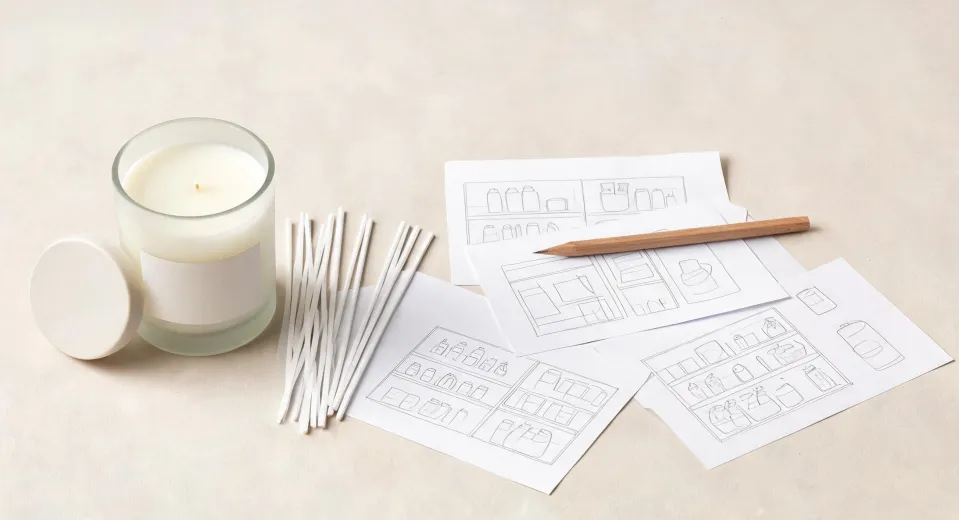
December 14, 2024. Pallet 14 of 28.
I was doing what I do every holiday season: final inspection of a corporate gift order before it left the mariposa warehouse. This one was 2,400 sets. Each kraft box held a scented candle and a small ceramic nativity set. The client — a regional healthcare network — wanted a holiday thank-you for their hospital staff.
The boxes looked beautiful. The mariposa logo was embossed cleanly. The brass ribbon was straight on every single unit we sampled. Then I pulled a candle from row three.
There it was. Frosting — a faint white crystalline pattern on the surface. If you didn't know what you were looking at, you'd never see it. But I knew. And frosting on a candle usually means soy wax.
That didn't make sense. We'd specified beeswax on this order. 100% beeswax. The client had asked for "premium candles," and in our spec sheet, premium meant beeswax.
I held a lighter to a wax shaving. Beeswax melts at 144–147°F. The shaving pooled almost immediately. That's not beeswax. Then I checked the certificate of analysis from the vendor. There it was in plain type: hydrogenated soybean oil.
Our vendor had substituted soy wax. And — here's the part that made my stomach drop — the nativity sets were already staged for assembly. The whole order was days from shipping.
I called the vendor's sales rep. His response: "Soy is a premium wax. We thought it complemented the nativity set nicely."
We'd used the same words and meant different things. "Premium wax" to him was something completely different than "premium wax" to us.
How We Got Here
The order came in October. Sarah, the client's procurement manager, asked for "premium scented candles" as part of a holiday gift set. First-time corporate client. We sent our standard spec sheet — five pages covering dimensions, packaging, fragrance load, labeling. On page two, line fourteen: wax type. Beeswax.
I'm not going to pretend that spec sheet was perfect. It was thorough. But line fourteen lived in a table with eleven other wax specifications, and I've done this long enough to know that the deeper a requirement sits, the more likely it is to get lost in the chain of hands between the client, our sales team, the vendor, and the production floor.
Somewhere in that chain, "beeswax" became "premium wax." And to a supplier that runs mostly soy, "premium wax" sounded like their bread and butter.
Look, the vendor should have flagged the substitution. They didn't. But now every contract we write includes the wax type in bold on page one.
Ship or Reject?
Two options.
Option A: ship the soy candles. They were honestly good. Clean burn, solid fragrance throw, and the frosting was visible on maybe one in twenty units — usually hidden underneath the lid. The client's procurement team wouldn't care. The nurses opening those boxes probably wouldn't notice either.
Option B: reject the batch, hold the nativity sets, and push the vendor to run the order again — this time in real beeswax. The problem: their production slot for December was full, and beeswax needs time to set. They quoted sixteen days. That put delivery after Christmas.
I went back and forth for two days. On paper, Option A was obvious. But I kept coming back to what the client actually asked for: premium. If we shipped them something that didn't match our spec, we weren't just failing a client — we were failing every nurse and technician who'd open one of those boxes expecting exactly what was promised.
I asked Sarah if she had a preference. (Honest answer: I was hoping she'd make the call for me.) Her email is still in my inbox:
"We don't care about the wax type. We care about the delivery date and the total cost. You're the quality experts. Tell me what you'd ship to your own clients, and that's what we'll take."
That email did not make me feel better.
What finally made the decision was a blind burn test with our packaging team. Same candle, same fragrance load, same size — eight people, two candles each. Every single person preferred the beeswax. Not because they could name it; most couldn't. They just said it "smelled cleaner" and "felt more expensive." That was enough.
I called Sarah and told her we were rejecting the batch.
The vendor pushed back, as expected. Then they offered to redo the run at their own cost, but on their "standard" timeline — which we all knew would miss Christmas.
Here's something vendors won't tell you: most "standard" timelines include buffer time. Their rush timeline is just removing the buffer they'd already built in. After some tense negotiation, they ran the beeswax in eleven days. The candles arrived at our dock on December 21. We assembled and packaged through the night on the 22nd, and the entire order went out on a late Christmas Eve freight run. (I remember meeting the driver at 11 PM with a thermos of coffee. He said he'd never seen a warehouse team cheer at the sight of a truck.)
After we hit ship, I kept second-guessing. What if the beeswax run had batch inconsistencies? What if the fragrance didn't cure right? I didn't relax until two weeks later, when Sarah emailed us a photo of the hospital staff lounge with the candles lined up on a table and a note: "Best gift we've given. People keep asking where they're from."
Soy vs Beeswax: What I Tell Every Client Now
So what's the actual best wax for candle making — soy or beeswax?
That's the wrong question, and I used to give it the wrong answer. People frame the choice as a quality hierarchy: beeswax is expensive, so it must be better. But the causation runs the other way. Beeswax costs more because it's a byproduct of honey production; supply is limited by how many bees exist. Soy wax comes from an abundant agricultural crop. The price gap is about supply chain, not quality.
Here's what I mean when I say soy isn't bad. Soy container wax has a lower melting point, which gives a cooler, slower melt pool — great in warm climates. It holds fragrance well, sometimes at ratios that would overpower beeswax. And it's vegan, which genuinely matters to some of our clients.
But soy has real quality-control trade-offs:
- Frosting and wet spots. Pure soy wax forms white crystalline patterns on the surface as it cools, and it shrinks away from the container walls. Purely cosmetic — but for a corporate gift, cosmetics are the product.
- The "soy" label problem. What most people don't realize is that many commercial soy candles are actually soy-paraffin blends. If you chose soy because you want a cleaner candle, the label alone doesn't guarantee it.
- Scent behavior. In our follow-up comparative testing in January 2025, beeswax threw a sharper cold scent and burned cleaner at the same fragrance load. Soy produced a warmer melt-pool scent in containers. Neither is better; they're different.
- Burn time. Beeswax is denser. You get roughly 20–30% more burn time from a beeswax candle than the same size soy candle (the National Candle Association publishes guidance on this).
If you're buying candles for your business, here's my checklist:
- Put the exact wax on the purchase order. "Premium" is not a material spec.
- Ask whether "soy" means pure soy or a blend. And get the supplier's answer in writing.
- Request the certificate of analysis from the first production run. Before you approve it, not after it ships.
- Burn test an actual production sample. Wax from a small test batch can behave differently in a full production run.
One last thing. mariposa means butterfly in Spanish. We get search traffic from people looking for other Mariposas — a town in California, a funeral home somewhere in the Midwest, a housing development with the same name. (Note to self: one day I'll figure out why so many completely unrelated businesses share our name.) But I like the butterfly metaphor for quality work: you inspect, you find the flaw, and then the product gets another chance to become what it was meant to be.
That's the story. Next time someone asks me whether beeswax is better than soy, I tell them the same thing I told Sarah: better isn't a property of wax. It's a property of the match between what you promise and what you deliver.

Elise Laurent is a crystal and decorative glass quality analyst covering crystal figurines, vases, ornaments, suncatchers, and gift glassware. She examines ISO 6486-1 where food-contact glass dinnerware applies, then uses polarized strain inspection, dimensional checks, surface-defect grading, and refractive clarity to compare decorative pieces outside that scope. Her work helps sourcing teams choose materials, finishing routes, and protective packaging without confusing visual brilliance with verified durability.