Mariposa Journal
What to Include in a Vacation Photo Book: A Cost Controller's Take
I am a procurement manager at a 40-person company. I have managed our corporate gift budget ($30,000 annually) for 6 years, negotiated with 40+ vendors, and documented every order in our cost tracking system. That is $180,000 in cumulative spending, maybe $185,000 if you count the year I forgot to move everything to the new spreadsheet.
If you are searching for what to include in a vacation photo book, I need to point out a problem before I give you an answer.
I look at cost differently now. A photo book has a cost per view. The price is not the number on the checkout page. It is the total cost divided by the number of times someone actually opens the book. (Should mention: I include shipping and hidden fees in this calculation.)
The Surface Problem: You Think It Is a Photo Selection Problem
The standard advice says to include your best photos from each day, then add a cover, an itinerary page, a few food shots, and a closing sunset. That is not wrong. It is just too vague to help.
In my first year, I made the classic specification error: I assumed a premium photo book would make a memory feel more important. It cost me $240, and it still sits under the living room table. I should add that I also paid extra for the custom box. The box is in a closet.
Most buyers focus on page count, paper weight, and cover finishes and completely miss the factor that matters more than all three: emotional context.
The question everyone asks is: Which photos should I print? The question they should ask is: What do I want someone to feel when they open this book?
The Deeper Problem: You Are Building Evidence Instead of Story
Vacation photo books fail because they are built as proof of where we went, not as a record of what it felt like. A photo of the Eiffel Tower proves you were there. A photo of your grandmother complaining about the menu while laughing proves it was real. Both have a place, but only one needs a caption.
This is why a photo book without captions is a box of images. Memory is triggered by context, not just pixels. The smell of a particular candle, the sound of rain, the name of a street. These details are not filler. They are the actual memory.
I worked this out one weekend at one of the Mariposa home rentals. The house was clean and comfortable, but what made it memorable was a small shelf with a framed photograph of a family trip and a candle that smelled like pine. Two objects, no design budget. A few weeks later, I walked through some Mariposa model homes and saw the same trick: a photo frame and a candle on a kitchen counter, making an empty house feel like a story. The same logic applies to a photo book. A book alone is documentation. A book with a place, a smell, and a frame is a scene.
The Cost of a Beautiful Album Nobody Opens
Let me put a number on this. When I audited our 2023 spending, I found that 22% of our corporate gift budget went to upgrades nobody remembered six months later. The leather cover, the foil-stamped logo, the gift box. What did they remember? The funny candid photo and the handwritten note.
The same pattern shows up in print buying. For reference, flyer printing for 1,000 copies runs $80 to $150 at online printers and $150 to $300 at local shops, based on publicly listed prices as of January 2025. Price does not equal result.
If a $50 photo book is opened 20 times, the cost per view is $2.50. If a $180 photo book is opened once, the cost per view is $180. That is the total cost of ownership (i.e., the price divided by usefulness, not the number on the receipt). My gut tells me this sounds too simple. My cost tracking system says otherwise.
What to Include in a Vacation Photo Book
Once the deeper problem is clear, the list is short.
- People. If I cannot identify someone in the photo, I probably do not include it. A place without people is scenery.
- One candid moment per day. Not 14. One flawed, true moment.
- A caption with a point. Include names, the place, and one sensory detail (meaning something you saw, heard, smelled, or tasted).
- The ordinary things. Coffee cups, rental keys, a rain jacket on a hook. These details bring the memory back.
- An ending page. Write a short note to the next person who opens the book, even if that person is future you.
Keep it under 30 pages. Around 24, maybe 28, depending on the trip.
Make the Book Part of a Scene
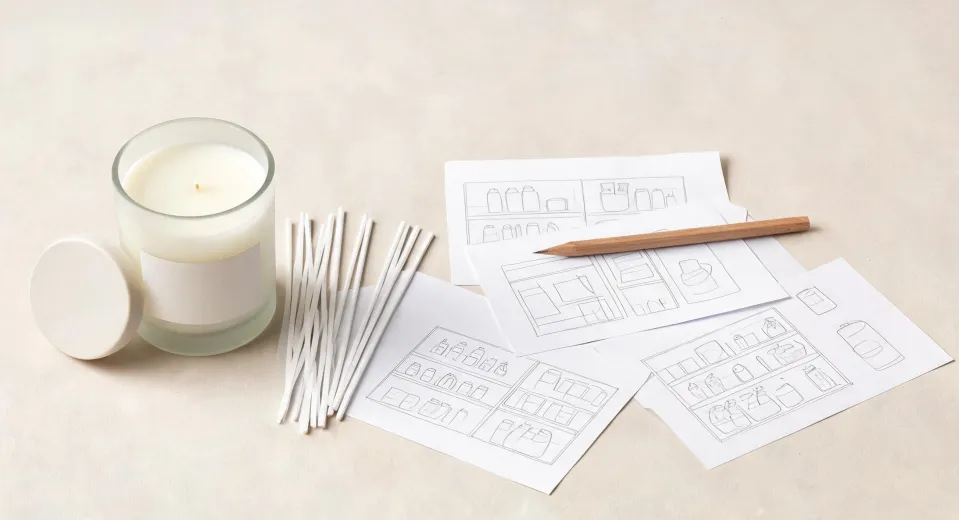
A photo book can be a beautiful object and still live inside a box. The last step is to put it somewhere visible. Pair it with a photo frame and a candle. The frame gives the eyes a place to rest. The candle gives the room a memory trigger.
At Mariposa, we make both of those. The frame and candle are the supporting cast. But the principle works with any decent frame and a scent that means something to you.
Small orders deserve this treatment too. If a supplier will not answer a question about a one-book order, find someone who will. The vendors who treated my $200 orders seriously are the ones I still use for $20,000 orders. Small does not mean unimportant. It means potential.
The Bottom Line
So what should you include in a vacation photo book? Start with a feeling, not a template. Include people, captions, ordinary details, one candid moment per day, and an ending note. Display it like it matters.
Skip every upgrade that does not make the book more likely to be opened. Use your budget where it counts: a good print, a photo frame, a candle, and a story.

Elise Laurent is a crystal and decorative glass quality analyst covering crystal figurines, vases, ornaments, suncatchers, and gift glassware. She examines ISO 6486-1 where food-contact glass dinnerware applies, then uses polarized strain inspection, dimensional checks, surface-defect grading, and refractive clarity to compare decorative pieces outside that scope. Her work helps sourcing teams choose materials, finishing routes, and protective packaging without confusing visual brilliance with verified durability.