Mariposa Journal
Mariposa Christmas Parade 2025, Mariposa Candle Numbers, and Facebook Photo Books: A Checklist From 11 Costly Mistakes
-
There is no one right way to order corporate gifts
-
Scenario A: The Christmas parade order - the date is not negotiable
-
Scenario B: Votive candle or reed diffuser? It's not about scent.
-
Scenario C: How to make a photo book from Facebook posts (start with the export, not the design)
-
How to tell which scenario you're in (without overthinking it)
There is no one right way to order corporate gifts
If anyone tells you there is a single formula for holiday gift ordering, they haven't placed enough orders. I've been handling corporate gift orders in the Mariposa catalog for six years. In that time, I've personally made and documented eleven significant mistakes. Total wasted budget: roughly $28,000. That doesn't include the colleague time wasted on reordering, unboxing, and apologizing.
The reason there's no universal answer is that different gifts fail in different ways. A public event gift fails if it arrives late. A corporate candle gift fails if the product detail is wrong. A memory gift like a photo book fails if the photos are blurry. Those are three different problems pretending to be one.
So, before browsing products, identify which of these three situations you're in:
- Scenario A: The event-forced deadline - for example, the Mariposa Christmas Parade 2025.
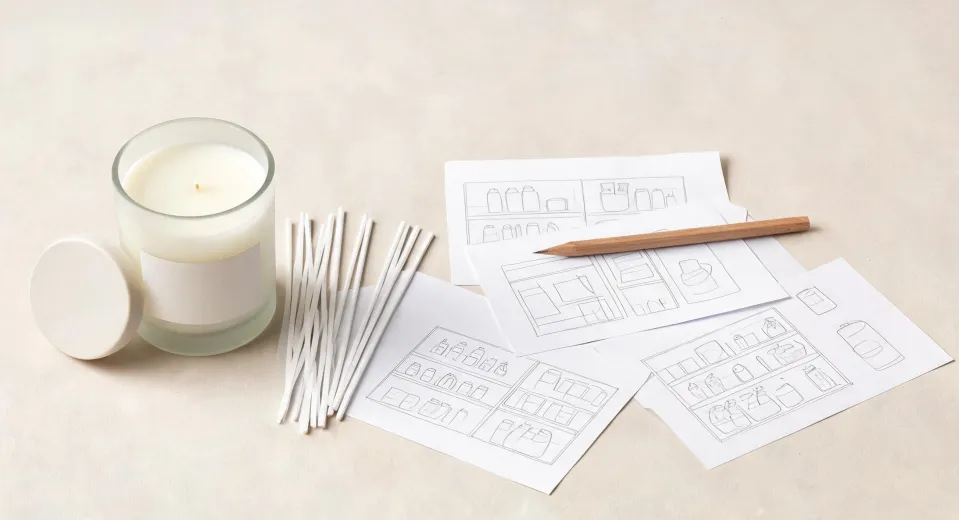
- Scenario B: The candle or diffuser product decision - votive candle vs. reed diffuser, plus the Mariposa candle numbers behind them.
- Scenario C: The photo book made from Facebook posts - and how to make it without low-resolution regrets.
Scenario A: The Christmas parade order - the date is not negotiable
Let's say your project involves the Mariposa Christmas Parade 2025. That phrase looks like a regular request. It's not. The date and route are public, the organizer has already shared the theme with local businesses, and by the time you're brought in, other people have made promises.
The biggest mistake isn't waiting too long. It's treating product selection like the first step. The first step is to calculate the deadline from the event date backwards. If the parade is on a Saturday morning, you don't just need the goods by Friday. You need them by the Tuesday before, or earlier, so someone can unpack and inspect every box before volunteers start distributing items.
Honestly, the parade order taught me more than any training session could. In Q3 2022, I handled giveaways for a similar holiday event. The organizer asked for event-branded votive candles, and I felt confident. I ordered using Mariposa candle numbers from an old internal spreadsheet. The candle numbers in that spreadsheet didn't match the current catalog - the new line had a different rim size. All 320 candles arrived, but they didn't fit the holders we'd also ordered. The replacement holders cost $890 and added a one-week delay. That was my first hard lesson about candle numbers.
What I mean is that ordering early is only useful if you've ordered the right things. Ordering early with the wrong product codes actually hurts, because it gives everyone a false sense of security.
For any event-driven order, do this instead:
- Get the event date in writing before discussing products.
- Request a physical sample or a current photo of the exact SKU, including any custom imprint.
- Use a live digital product list. The printed brochure changes slower than the catalog, and those changes cause the exact kind of mistake I made.
- Ask for a confirmation email that includes quantity, product numbers, imprint, and the delivery date. If 'estimated' appears next to the date, it's an estimate.
One more thing: quick, correct, cheap. Pick two. For an event, correct and quick are the only acceptable combo.
Scenario B: Votive candle or reed diffuser? It's not about scent.
Votive candles and reed diffusers are two of the most common corporate gifts we fulfill. The common assumption is that you choose based on the recipient's scent preference. I used to think that too. Then I compared two orders side by side: one with 120 votive candles, one with 120 reed diffusers, going to the same region in July. The candle order had a 12% breakage and melt rate. The diffuser order arrived 100% intact. When I compared the total cost, the diffuser was actually cheaper for shipped gifts.
From the outside, votive candles feel more thoughtful. The reality is that a thoughtful gift is one that works on the first try. A reed diffuser doesn't need a flame, doesn't melt in the back of a truck, and lasts 60 to 90 days. A votive candle creates more visual drama, but it comes with an instruction list: use a holder, keep it away from curtains, don't leave it burning.
If you do order votive candles, the critical detail is the candle number and holder compatibility. Mariposa's catalog numbers are not intuitive. On one order, I typed the product code 4001 thinking it meant a quantity of 4,001. It actually meant style #4001, which is a votive holder. (note to self: 'numbers' is a dangerous word in a gift order; always ask whether it's a product code or a piece count.)
As of January 2025, I still default to the reed diffuser for shipped corporate gifts. It's not the opening of a ceremony; it's the kind of gift that arrives in one piece and sits on a desk for two months. If you need an immediate scent throw for a dinner table, choose a votive. If you need a gift that survives, choose the diffuser.
One time I had about an hour to decide between the two for a last-minute client gift. I should have checked shipping routes and weather. There wasn't time. I went with the diffuser because it would most likely arrive intact. Didn't relax until the client sent a 'received, thanks' photo. (It worked.)
Scenario C: How to make a photo book from Facebook posts (start with the export, not the design)
Another common request: 'Can you turn our Facebook posts into a photo book?' It's personal, it feels easy, and it's full of traps.
The surface trap is that Facebook photos are already the real photos. In reality, social media compresses images. A photo that looks perfectly sharp on a phone may be 960 pixels wide, which is too small for a full-page 8x8 print. You need a resolution jump.
Here's the process I use now:
- Use Facebook's own export tool: Settings & Privacy, then Settings, then Your Facebook Information, then Download Your Information. Select only Photos and Videos, choose the date range, and request the highest available quality.
- If someone posted photos from a specific event and you only need one album, check whether the album has a Download album option. That saves time.
- Don't rely on screenshots. I once did that for a cover photo, and the printed title was unreadable. $450 later, I stopped doing it.
- Ask participants to contribute originals whenever possible. A shared Google Drive or Dropbox folder is more reliable than exporting from Facebook.
- Before ordering, use the printer's software to spot pixel warnings. If the image is below roughly 1000 px on the long side, it will look soft at 8x8.
For standard photo books, an online print provider works well for quantities from 25 to 25,000+. Standard turnaround is 3-7 business days. The value isn't just the price - it's the certainty of a confirmed delivery date. For a one-off personal book, a local print shop might be faster. For bulk orders, the online route wins on consistency.
Switching from grabbing photos manually to exporting once with the native tool cut our photo book layout time from four days to one. It also eliminated the low-res surprises that used to force reprints.
How to tell which scenario you're in (without overthinking it)
When a request doesn't fit neatly, ask yourself one question: what would hurt most if this order failed?
- If a missed date would hurt most - you're in Scenario A. Treat the project as a deadline problem. Every decision should reduce delivery risk.
- If damaged or unusable product would hurt most - you're in Scenario B. Focus on product specifications, packaging, shipping, and total cost.
- If disappointed emotions would hurt most - you're in Scenario C. Treat it as a content-quality problem. Get the best resolution and permission before touching layout.
Another clue: if the request is for a public event like the Mariposa Christmas Parade 2025, it's almost always Scenario A. If the request mentions a product name like votive candle or reed diffuser, it's Scenario B. If it mentions photos from Facebook, it's Scenario C.
I've kept a version of this checklist on our team wall for the past 18 months. It has caught 47 potential errors before any money was spent. Forty-seven. Most were small - wrong number, wrong quantity, wrong building address - but small errors have a funny way of becoming expensive ones.
Bottom line: good gift ordering isn't about being clever. It's about identifying which thing can break, then checking that thing. That's not the exciting part of the job, but it's the part that separates a gift that gets used from a gift that becomes a story about $890 candle holder replacements.

Elise Laurent is a crystal and decorative glass quality analyst covering crystal figurines, vases, ornaments, suncatchers, and gift glassware. She examines ISO 6486-1 where food-contact glass dinnerware applies, then uses polarized strain inspection, dimensional checks, surface-defect grading, and refractive clarity to compare decorative pieces outside that scope. Her work helps sourcing teams choose materials, finishing routes, and protective packaging without confusing visual brilliance with verified durability.